Fraud Detection Software for Financial Crime Prevention
Identify fraudulent transactions before they are processed using real-time rule-based scenarios, AI-driven anomaly detection, and risk-scored alerting built for compliance teams.
TRUSTED BY OVER 800+ CLIENTS


Stop fraud before it moves through your system
Every transaction is evaluated in real time against configurable fraud scenarios, peer-group behaviour baselines, and risk thresholds — so your team acts on genuine threats, not noise.

100+
PRE-BUILT RULE SCENARIOS

<1s
REAL-TIME DETECTION

220+
JURISDICTIONS COVERED

800+
COMPLIANCE TEAMS
Real-Time Transaction Fraud Detection
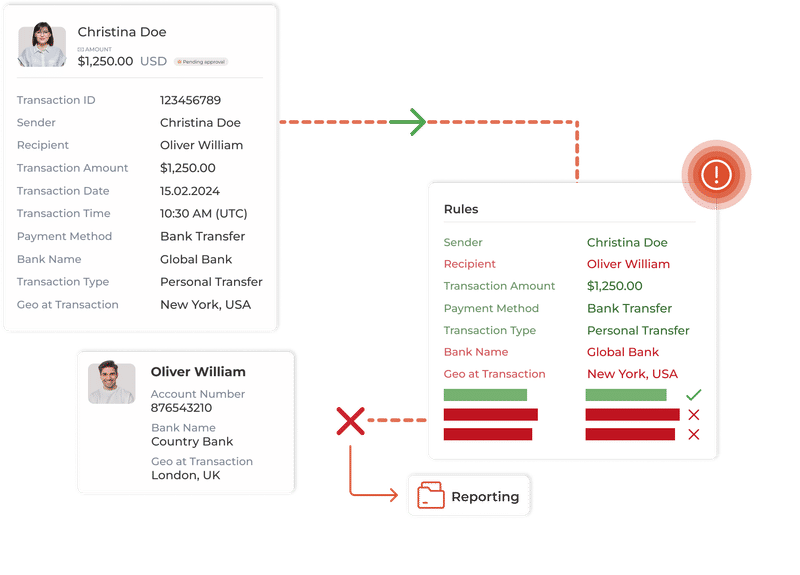
Every transaction is evaluated the moment it enters the system. If a defined rule or anomaly threshold is triggered, the transaction is flagged or blocked before any funds move.
Configurable Rule-Based Scenarios
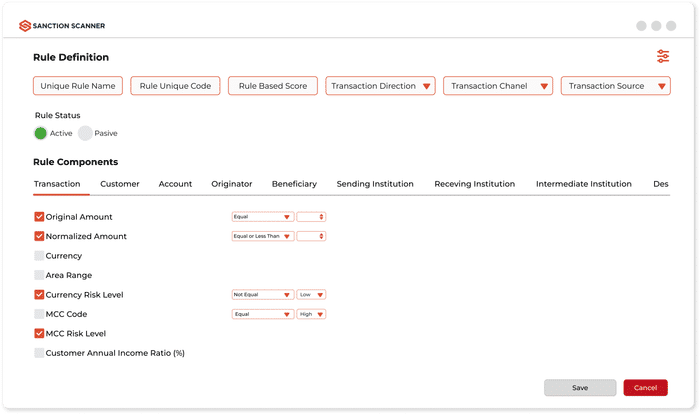
Build fraud detection logic without writing code. Define thresholds, transaction patterns, account behaviour rules, and time-window conditions — then deploy instantly without engineering work.
AI-Driven Anomaly Detection
Machine learning models analyse transaction history and peer-group behaviour to surface activity that deviates from expected patterns — catching fraud that fixed rules would miss.
Risk-Scored Alerting
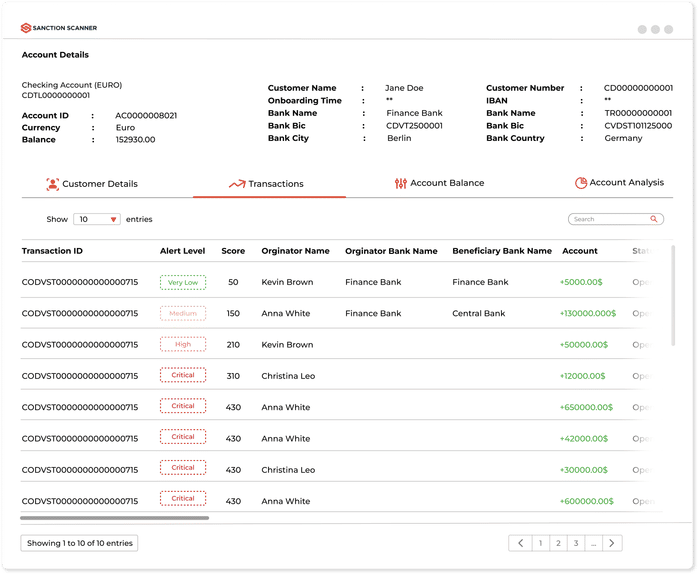
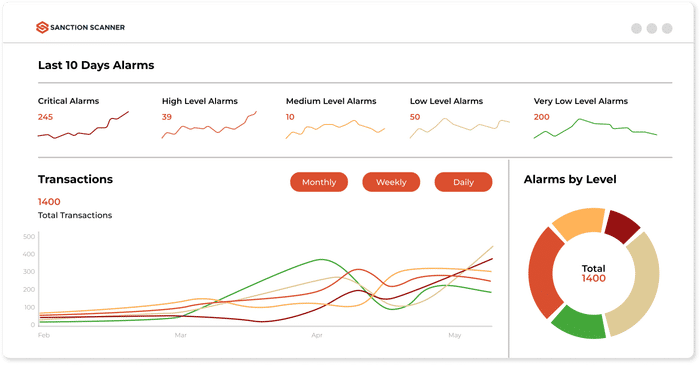
Every flagged transaction carries a risk score so analysts prioritise what matters. High-confidence detections can trigger automatic blocks; lower-confidence cases go to a review queue.
Everything your fraud team needs to detect, investigate, and act
Create and modify fraud detection scenarios without developer involvement. Drag-and-drop logic, condition grouping, and threshold configuration are all available in a UI your compliance team can operate directly.
Set different sensitivity levels by product, customer segment, geography, or transaction type. High-value cross-border transfers can run at full sensitivity while low-risk domestic payments use lighter logic.
Analysts see all active alerts, risk scores, transaction details, and case history in one view. Filter, sort, and triage alerts without switching between tools or pulling separate reports.
Track behaviour patterns at the account level over rolling time windows. Velocity checks, unusual login patterns, and sudden transaction volume spikes are detected and surfaced automatically.
Flagged transactions flow directly into case management. Analysts add notes, attach evidence, record decisions, and escalate within the same platform — with a full audit trail preserved automatically.
Integrate fraud detection directly into your core banking system, payment gateway, or card processor. A single API call submits a transaction; results come back in milliseconds.

Embedded in your transaction flow from day one
Sanction Scanner’s API is built for high-throughput environments. Connect your payment engine or core banking system and have fraud detection running in production within hours — with sub-second response times that keep the customer experience intact.
- No API integration fees
- No server costs
- Sub-second average response time
- Works alongside your existing AML stack
Trusted by compliance and risk teams detecting fraud at scale
"Since implementing Sanction Scanner, we have significantly reduced false positives. The time we previously spent on false positive alarms can now be directed towards other aspects of the business."

Guy Shaked
Legal Counsel at ironSource
"What I like best is the real-time screening capability and automated alerts. It helps us detect potential matches instantly and take immediate action, which is critical for our AML compliance."

Tolgahan Kapanci
Head of Compliance at PeP
"Sanction Scanner provided us the most comprehensive database to screen our clients. It includes lists from all over the world and is always up to date."

Gulnihal Akartepe
Global Vice President at TPAY
How BPN reduced false positives and made screening operationally sustainable
BPN, a payment and e-money services company, needed a screening setup that could handle high transaction volumes without overwhelming their compliance team. Here’s how they did it.
Read the case study →
Frequently asked questions
Fraud detection software analyses transactions in real time to identify patterns associated with fraudulent activity — such as unusual transaction velocities, atypical geographic behaviour, or transactions that match known fraud typologies. When suspicious activity is detected, the system flags or blocks the transaction and alerts your compliance team for review.
Rule-based fraud detection evaluates each transaction against a set of predefined conditions. For example, a rule might flag any transaction over €10,000 from a new account, or any sequence of three transfers to the same beneficiary within 60 minutes. When a transaction satisfies the conditions of a rule, an alert is raised. Rules can be configured without code, giving compliance teams direct control over detection logic.
AI-driven anomaly detection uses machine learning models to establish a behavioural baseline for each customer or account. When a transaction deviates significantly from that baseline — even if it does not match any fixed rule — the model assigns a higher risk score and surfaces it for review. This catches novel fraud patterns that rule-based systems have not yet been updated to detect.
Fraud detection focuses on identifying individual transactions or accounts engaging in deceptive or financially harmful activity, such as account takeover, identity fraud, or payment fraud. AML transaction monitoring looks for patterns across a customer’s full transaction history that may indicate money laundering, such as structuring or unusual cash movements. Both are important layers in a financial crime compliance programme, and they work best when integrated.
Yes. Sanction Scanner’s no-code rule builder allows compliance teams to create, modify, and deploy fraud detection scenarios directly through a user interface. You can define conditions, set thresholds, apply time windows, and activate rules without any engineering work. Changes take effect immediately, so your detection logic can respond to new fraud patterns as quickly as they emerge.
Sanction Scanner’s fraud detection API returns results in under one second on average. This means detection happens within the transaction flow itself — before the payment is processed — without adding perceptible delay for the end user. High-throughput environments such as payment processors and digital banks can run fraud checks at full volume without performance degradation.
Fraud detection is critical for any business processing financial transactions. The highest-risk industries include digital banking, payment services providers, e-money institutions, remittance companies, online gaming, cryptocurrency exchanges, and insurance. Any business that processes customer payments and is subject to financial crime regulations can benefit from real-time fraud detection integrated into their transaction flow.
Yes. Flagged transactions flow automatically into case management, where analysts can review the full alert context, add investigation notes, attach supporting evidence, record their decision, and escalate if needed. Every action is logged with a timestamp and user attribution, creating a complete audit trail for regulatory review without any additional preparation.
Each flagged transaction receives a risk score based on the number of rules triggered, the severity of each rule, and the confidence level of any AI anomaly signals. High-risk transactions can be configured to trigger automatic blocks, while medium-risk transactions go to a review queue ordered by score. This lets your team prioritise their time on the cases most likely to represent genuine fraud.
Integration is via REST API. You submit a transaction payload to the fraud detection endpoint and receive a risk score and alert status in response, typically within one second. Sanction Scanner provides comprehensive developer documentation, sandbox testing environments, and onboarding support to get your integration live quickly. There are no API integration fees or server costs.