
Growing fast is the goal. Outgrowing your compliance program is the risk.
Fintechs and payment processors were fined over $160 million in 2025 for one recurring failure: customer acquisition outpacing compliance infrastructure. Sanction Scanner gives fast-growing fintechs the AML screening, monitoring, and risk tools that scale with them not behind them.
TRUSTED BY OVER 800+ CLIENTS


The three ways fast-growing fintechs get caught out.
Regulators are no longer giving fintechs a grace period for growth. The assumption that compliance can be bolted on later is exactly what is driving enforcement.
Revolut was fined €3.5 million for AML control failures. Yours could be next.
In 2025, fines against fintechs and payment processors exceeded $160 million globally and the pattern is consistent: onboarding too fast, screening too slow. The regulators’ message is clear: growth does not exempt you from AML obligations.
For fintechs, AML compliance is not just a regulatory requirement. It is a due diligence item in every fundraising round, every banking-as-a-service partnership, and every enterprise sales process. Weak controls do not just attract regulators they cost you deals, partnerships, and the banking relationships your product depends on.
Rules-based AML systems generate enormous volumes of false positives and for fast-growing fintechs with lean compliance teams, that volume is unmanageable. Every hour spent clearing false alerts is an hour not spent on genuine risks. Automation is not just an efficiency play. It is what keeps your team focused on real threats.
AML compliance doesn’t stop at onboarding. Neither do we.
Every module connects to your fintech stack via API in days, not months.

Screen every customer at onboarding in seconds, not minutes
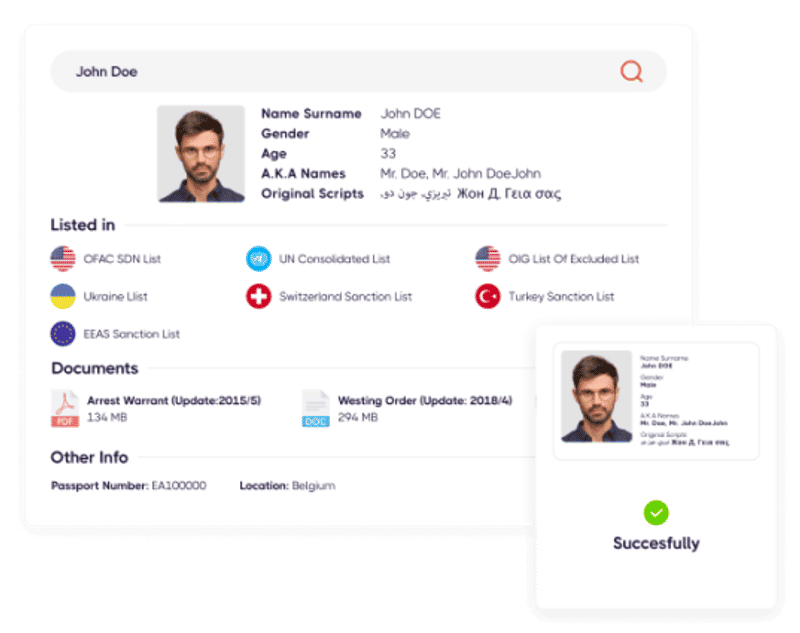
Before a customer accesses your platform, Sanction Scanner screens them against 3,000+ sanctions lists, PEP databases, and adverse media sources across 220+ countries. Data updated every 15 minutes. Fast enough for frictionless onboarding. Thorough enough to satisfy regulators.
AML Screening →Detect suspicious activity before it becomes a SAR filing
Transaction Monitoring gives your compliance team real-time surveillance with configurable rules and AI-powered risk scoring. As your transaction volumes grow, the platform scales automatically. You set the thresholds. The system flags the anomalies.
Transaction Monitoring →Screen every sender and receiver, automatically
For fintechs handling payments and transfers, Transaction Screening checks both sides of every transaction against global sanctions and watchlists in 150ms via API, in the background, without adding friction to the payment flow.
Transaction Screening →Know exactly who is behind every business account
Fintechs increasingly serve business customers as well as individuals. KYB verifies company structures, identifies Ultimate Beneficial Owners, and flags hidden risks before they become your compliance problem.
Know Your Business →Risk-score every customer, not just the flagged ones
Customer Risk Assessment assigns dynamic risk scores based on profession, geography, transaction behaviour, and more. Your team applies enhanced due diligence where it is genuinely needed — not uniformly across every customer, which wastes time and misses the real risks.
Customer Risk Assessment →Re-screen your entire customer base automatically, every day
Ongoing Monitoring re-screens every customer in your portfolio on a daily basis and alerts your team the moment a risk status changes. No manual triggers. No gaps in your monitoring cycle between onboarding and the next review.
Ongoing Monitoring →Live in days. Built for your stack. Fintechs cannot afford slow implementations. Sanction Scanner integrates via a RESTful API with webhook support, designed for the API-first architectures that fintechs already run.
API Integration →Built for the frameworks that govern fintech compliance
From GDPR to PSD2 to FinCEN rules on money services businesses. Sanction Scanner maps to every framework governing fintechs globally.
Real-time screening against OFAC SDN and Consolidated lists, with reporting support aligned to FinCEN requirements for money services businesses and payment processors handling customer funds.
Strong customer authentication, transaction monitoring, and fraud detection aligned with European Banking Authority expectations for payment service providers and e-money firms.
Configurable rule sets and full audit trails designed to meet FCA expectations for authorised payment institutions, e-money firms, and high-risk fintech activities.
Built with data minimization and consent principles at the core. Compliant with GDPR requirements for customer data handling and consent tracking across all screening and monitoring activities.
Originator and beneficiary data screening for transfers above threshold. Supports Travel Rule compliance for cross-border payment activities.
Designed to support compliance with EU 6th and 5th AML Directives, including beneficial ownership verification, sanctions screening, and ongoing transaction monitoring obligations.
How a fintech scaled AML screening without slowing down customer onboarding
A fast-growing fintech needed a compliance setup that could keep pace with their customer acquisition without creating friction in the onboarding flow. Here’s how they built AML compliance that scaled with their growth.
Read the case study →
Build compliance into your growth, not on top of it.
Book a demo with our team. We will show you how Sanction Scanner fits your product architecture, your transaction volumes, and the regulatory frameworks you operate under.
Request a Demo