PEP Database for AML Compliance Screening
Global coverage of politically exposed persons, their relatives, and close associates — structured, classified, and continuously updated across 220+ countries.
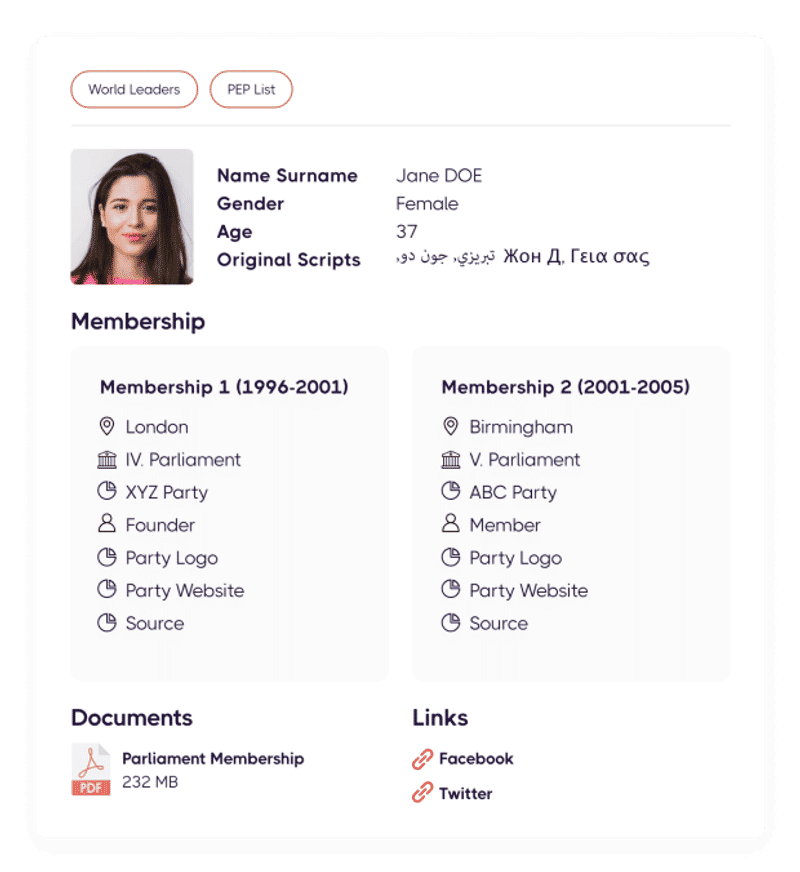
TRUSTED BY OVER 800+ CLIENTS


PEP coverage that goes beyond the individual
Coverage of the named PEP alone is not enough. Regulators require the full risk network.
Politically Exposed Persons
Current and former PEPs across all levels of public office and political function globally, across 220+ countries. Coverage is continuously updated as individuals enter or leave politically exposed status.
Relatives and Close Associates (RCA)
Regulators require screening beyond the PEP themselves. The database includes spouses, children, parents, and individuals with known close personal or professional ties to PEPs — so your compliance program captures the full risk network.
Structured Classification
Every PEP record is classified within a broad, structured category system enabling compliance teams to identify the nature of the political exposure, apply the appropriate level of due diligence, and prioritise reviews based on role type and seniority.
Continuous Updates
PEP status changes. The database is continuously monitored and updated — not refreshed on a quarterly cycle — so your screening always reflects current status when individuals enter or leave politically exposed positions.
The scale behind the coverage
PEP records and counts change constantly as individuals enter and leave public office. What matters is that coverage is global, classification is structured, and the data is always current — all three are true of Sanction Scanner's PEP database.

220+
COUNTRIES COVERED

Global
RCA COVERAGE INCLUDED

15 min
MAX DATA REFRESH
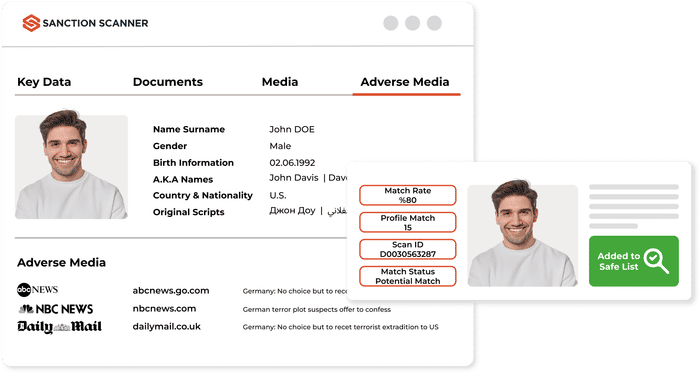
The risk doesn’t stop at the PEP
Regulators including FATF and the EU Anti-Money Laundering Directives specifically require financial institutions to identify and apply enhanced due diligence to the relatives and close associates of PEPs — not just the PEPs themselves.
Records are categorised within a three-tier class structure covering heads of state through to municipal officials and state-owned company executives — enabling differentiated due diligence workflows based on role and seniority.
PEP records are indexed against known aliases and name variants, including original-script forms in Arabic, Cyrillic, Chinese, and other alphabets.
Each record includes structured data fields, dates, roles, jurisdictions, known associates, and risk classification — full context for informed due diligence decisions.
Access global PEP data via API
Sanction Scanner's PEP database is accessible via API. Query by name, ID number, or passport number and receive structured, enriched results in seconds. Batch query support enables bulk lookups for portfolio screening and high-volume onboarding environments.
Export functionality supports audit and reporting requirements.
Explore Developer Docs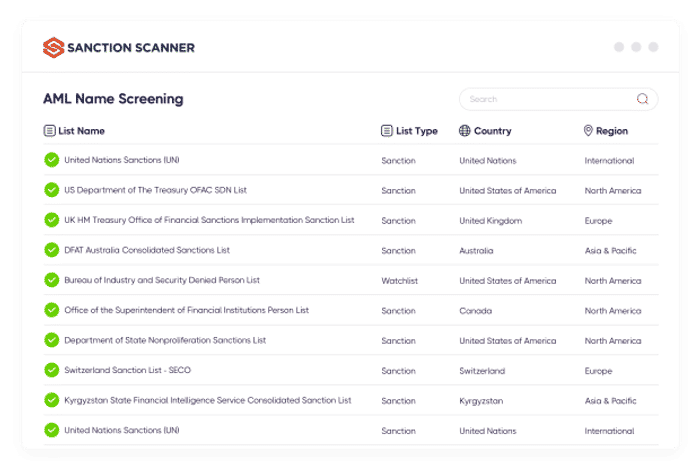
What compliance teams say about Sanction Scanner
"Sanction Scanner provided us the most comprehensive database to screen our clients. It includes lists from all over the world and is always up to date."

Gulnihal Akartepe
Global Vice President at TPAY
"What I like best about Sanction Scanner is its real-time screening capability and automated alerts. It helps us detect potential matches instantly and take immediate action, which is critical for our AML compliance."

Tolgahan Kapanci
Head of Compliance at PeP
How BPN reduced false positives and made screening operationally sustainable
BPN, a payment and e-money services company, needed a screening setup that could handle high transaction volumes without overwhelming their compliance team. Here’s how they did it.
Read the case study →
PEP data at the core of your compliance program
Frequently asked questions
A politically exposed person is an individual who holds or has held a prominent public position — such as a head of state, government minister, senior judicial official, military officer, or senior executive of a state-owned enterprise. Because of their position, PEPs are considered higher risk for involvement in bribery, corruption, or misuse of public funds, and require enhanced due diligence under most AML frameworks.
FATF recommendations and EU Anti-Money Laundering Directives specifically require regulated institutions to apply enhanced due diligence not only to PEPs themselves but also to their relatives and close associates — because the financial crime risk associated with a PEP extends to those in their immediate network. A compliance program that only screens the named PEP leaves a significant regulatory gap.
Yes. Individuals who previously held politically exposed positions are included in the database. FATF guidance requires a risk-based assessment of former PEPs — many jurisdictions maintain enhanced due diligence requirements for a defined period after an individual leaves public office.
The database is continuously monitored and updated — not on a scheduled quarterly or annual refresh cycle. When an individual enters or leaves politically exposed status, or when a known associate relationship changes, the record is updated. The maximum data refresh interval across all sources is 15 minutes.
Coverage is global across 220+ countries. Both domestic and foreign PEPs are included — meaning a bank in one country can screen against PEPs from any other jurisdiction in the same query.
Records are classified within a three-tier structure. Class 1 includes the highest-risk political roles — heads of state, cabinet ministers, central bank governors, royal members, and chiefs of armed forces. Class 2 covers senior judicial officials, ambassadors, capital city mayors, senior military members, and intelligence service directors. Class 3 includes municipal officials, state-owned company executives, central bank directors, and national party members. This classification enables compliance teams to prioritise reviews and calibrate due diligence intensity based on the tier and role type of the match.
Yes. The full PEP database — including RCA records — is accessible via Sanction Scanner's API. Query by name, ID number, or passport number and receive structured, enriched results in seconds. Batch query mode supports bulk lookups for high-volume screening environments.
Yes. FATF recommendations, EU Anti-Money Laundering Directives, and most national AML frameworks require regulated institutions to identify PEPs among their customers and apply enhanced due diligence to the relationship. This applies at onboarding and on an ongoing basis throughout the customer lifecycle.