AML Screening Software for Compliance Teams
Screen every customer against global sanctions lists, PEP databases, and adverse media sources in real time — from onboarding onwards.
TRUSTED BY OVER 800+ CLIENTS


Everything your screening program needs in one place
Every data source — sanctions lists, PEP databases, adverse media feeds — is included in your plan. No separate data subscriptions, no licensing add-ons.

3,000+
GLOBAL DATA SOURCES

220+
COUNTRIES COVERED

15 min
MAX DATA REFRESH

150ms
AVG RESPONSE TIME


Fewer false positives. No missed matches.
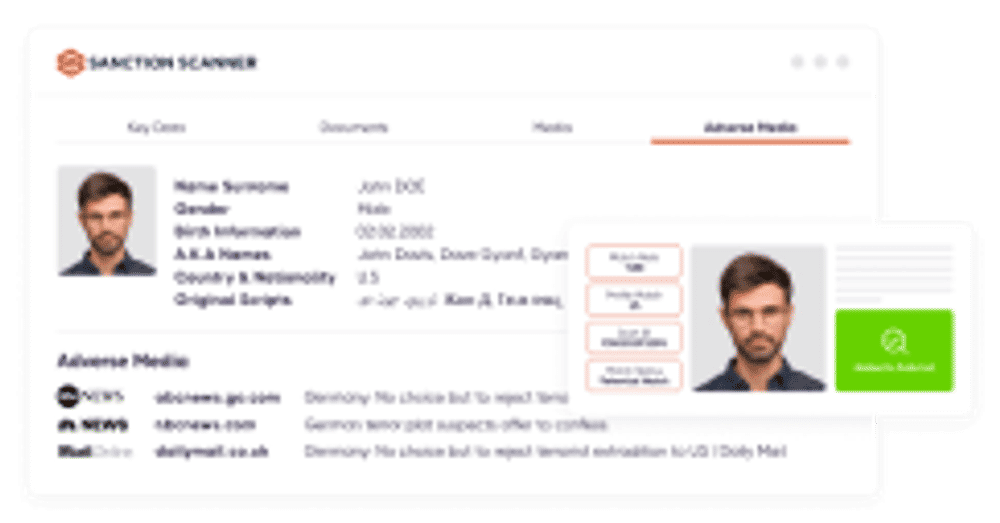
Name screening only works if the matching logic behind it is reliable. Too sensitive and your analysts drown in false alerts. Too loose and real risks slip through. Sanction Scanner uses AI-driven fuzzy matching to catch name variations, aliases, transliterations, and misspellings across all supported alphabets — without generating noise that slows your team down.
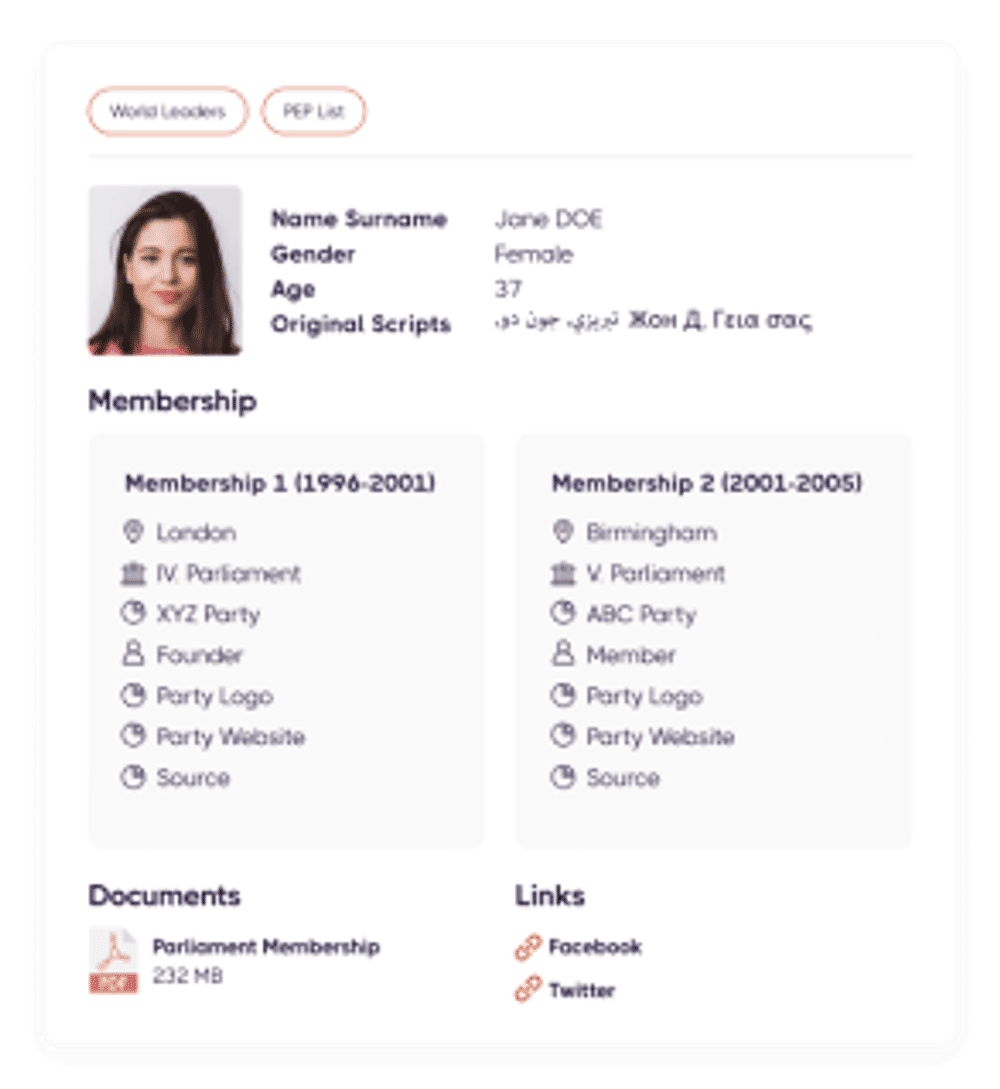
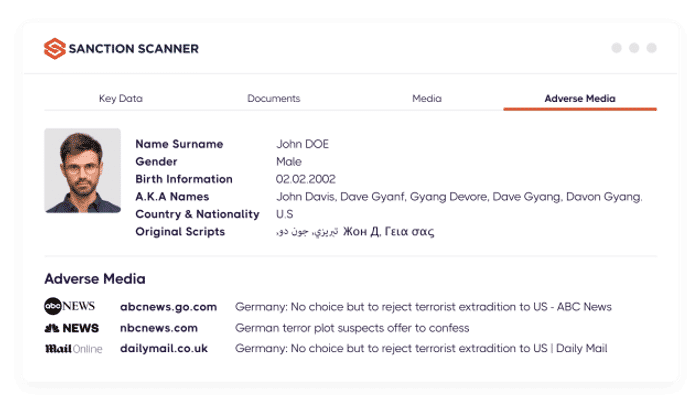
Screen names in any script — Latin, Arabic, Cyrillic, and more — with automatic transliteration so no variant falls through the gap.
Apply different sensitivity settings for retail customers, corporate entities, or high-risk segments. Your risk policy drives the system, not the other way around.
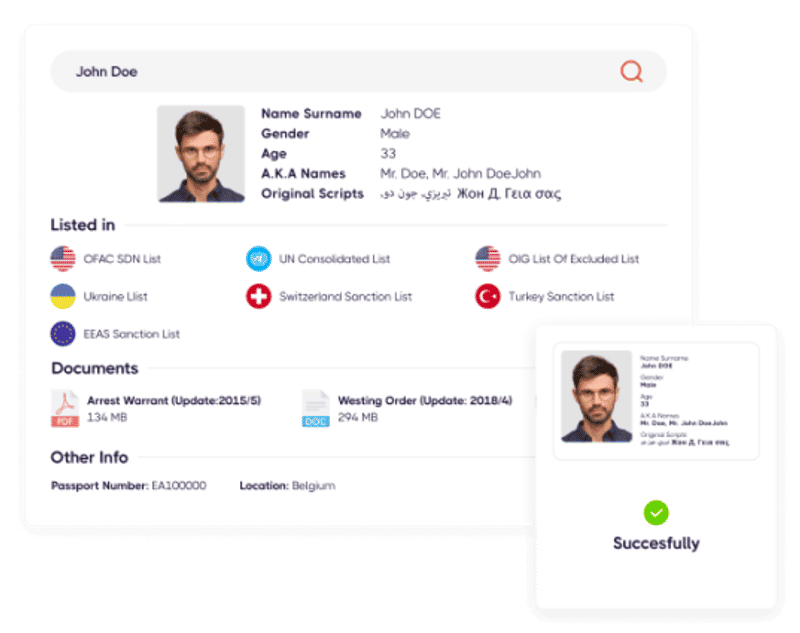
When a potential match is flagged, analysts see a consolidated profile pulling together all available data on that entity — so decisions are made with full context, not fragments.
Built for compliance teams that move fast and stay accurate
Screen one customer at onboarding or run your entire portfolio at once. Both modes use the same data sources and matching logic.
Search by name, date of birth, nationality, ID number, or passport — combine identifiers to sharpen results.
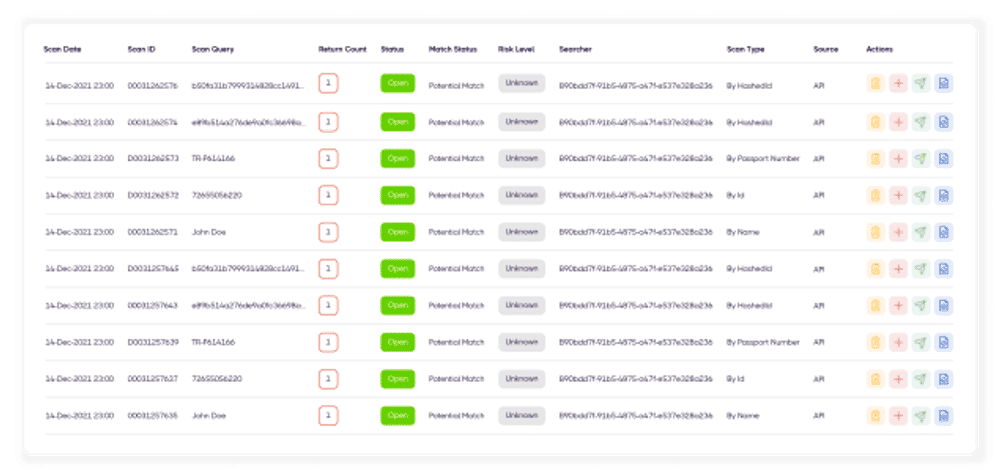
Every scan, match, and analyst decision is logged automatically. When a regulator asks, your records are ready.
Upload your own blacklists and whitelists alongside global data sources inside the same screening workflow.
Query results can be translated into your team's language for globally distributed compliance operations.
Review flagged matches, annotate decisions, escalate or dismiss cases — all within the platform, without switching tools.

Live in hours, not weeks
Sanction Scanner's API is built to fit your existing stack. Connect your onboarding flow, CRM, or case management system and have screening running in production within a day.
Webhook support enables two-way data transfer so your systems stay in sync automatically — no manual exports, no batch delays.
- No API integration fees
- No server costs
- 150ms average API response time
- No separate data subscription — everything is included
What compliance teams say about Sanction Scanner
"Since implementing Sanction Scanner, we have significantly reduced false positives. The time we previously spent on false positive alarms can now be directed towards other aspects of the business."

Guy Shaked
Legal Counsel at ironSource
"What I like best is the real-time screening capability and automated alerts. It helps us detect potential matches instantly and take immediate action, which is critical for our AML compliance."

Tolgahan Kapanci
Head of Compliance at PeP
"Sanction Scanner provided us the most comprehensive database to screen our clients. It includes lists from all over the world and is always up to date."

Gulnihal Akartepe
Global Vice President at TPAY
How BPN reduced false positives and made screening operationally sustainable
BPN, a payment and e-money services company, needed a screening setup that could handle high transaction volumes without overwhelming their compliance team. Here's how they did it.
Read the case study →
Complete your onboarding compliance stack
Frequently asked questions
The platform screens against 3,000+ global and local sources including OFAC, UN, EU, and HMT sanctions lists, structured PEP databases, and adverse media feeds updated every 15 minutes. You can also upload custom internal lists to run alongside global data.
Yes. FATF recommendations, EU Anti-Money Laundering Directives, FinCEN rules, and most national AML frameworks require regulated businesses to screen customers against sanctions and PEP lists at onboarding and on an ongoing basis.
Yes. Screening customers against sanctions lists, PEP databases, and adverse media is a required component of Know Your Customer due diligence under FATF recommendations, EU Anti-Money Laundering Directives, and most national AML frameworks. It applies at onboarding and on an ongoing basis throughout the customer relationship.
Fuzzy matching identifies names that are similar but not identical — covering aliases, spelling variations, and transliterations. Without it, a sanctioned individual could pass undetected simply by using a slightly different name format.
By combining multiple identifiers (name, date of birth, nationality, ID number) with configurable match thresholds and AI-driven context logic, the platform significantly reduces irrelevant alerts without increasing missed detections.
At minimum, at customer onboarding. Best practice is continuous monitoring so that any change in sanctions status, PEP designation, or adverse media coverage is caught as it happens — not at the next scheduled review.
Yes. Sanction Scanner supports screening across multiple alphabets and scripts with automatic transliteration, and query results can be translated into your team's language.
Yes. Custom blacklists, whitelists, and internal risk databases can be uploaded and managed within the platform, screening against them in the same workflow as global data sources.
A match triggers an alert with a consolidated profile view of the flagged entity. Your team can review the match, apply context, annotate their decision, and escalate or dismiss the case — all with a full audit trail.
Yes. The API-first architecture is built for integration into CRMs, onboarding platforms, and case management systems. Most teams are live within a day.