Customer Risk Assessment Software for AML Compliance
Score every customer at onboarding, classify them by risk level, and apply the right level of due diligence automatically — without writing a single line of code.

TRUSTED BY OVER 800+ CLIENTS


Score and classify every customer from the moment they onboard
Risk scores are calculated automatically based on the criteria you define — customer type, geography, industry, transaction profile, PEP status, and more. Classifications update automatically when customer profiles change.

50+
CONFIGURABLE RISK FACTORS

150ms
AVERAGE SCORE RESPONSE

220+
JURISDICTIONS COVERED

800+
COMPLIANCE TEAMS
Risk Scoring at Onboarding
Assign a risk score to every customer the moment they enter your system. Scores are calculated automatically based on the criteria you define — customer type, geography, industry, transaction profile, PEP status, and more.
Dynamic Risk Classification
Customers are classified into risk tiers — low, medium, high, and critical — with thresholds you set. Classifications update automatically when customer profiles change, so your risk picture stays current without manual reassessment.
No-Code Rule Engine
Build and adjust risk scoring rules without developer support. Define scenarios, set weightings, and fine-tune thresholds directly in the platform — using ready-made rule sets as a starting point or building from scratch.
SDD and EDD Routing
Route customers automatically to Simplified Due Diligence or Enhanced Due Diligence based on their live risk score. The right level of scrutiny is applied consistently, without manual triage.
From customer data to risk decision in seconds

Configure the factors that drive your scoring model — customer type, country of residence, source of funds, business sector, PEP status, and any custom variables relevant to your risk appetite.
Every new customer is scored automatically the moment they enter your onboarding flow. No manual assessment, no delays.
Customers are assigned to a risk tier — low, medium, high, or critical — and routed to the appropriate due diligence workflow automatically.
Risk scores update dynamically as customer profiles evolve. When a score changes, your team is alerted and the customer’s workflow is adjusted accordingly.
All scoring decisions, rule applications, and risk tier changes are logged automatically. Every assessment is traceable and audit-ready.
Your compliance team has full control over scoring logic
Define risk factors, assign weightings, and set score thresholds without writing code. The model reflects your internal risk policy, not a generic template.
Start with pre-built rule sets designed for banking, fintech, payments, crypto, and other regulated industries. Adapt them to your specific requirements or use them as a baseline.
Scores recalculate automatically when customer data changes — new transaction patterns, updated geography, PEP designation, or adverse media exposure. No scheduled batch reassessment required.
When a customer moves from one risk tier to another, your team is notified immediately. Escalation workflows trigger automatically based on the thresholds you define.
Combine customer attributes — profession, age, income level, country, currency, transaction behaviour — into a single weighted score.
Every rule application, score calculation, and tier change is recorded. Regulatory review-ready at any point without additional preparation.
Embedded in your onboarding flow from day one
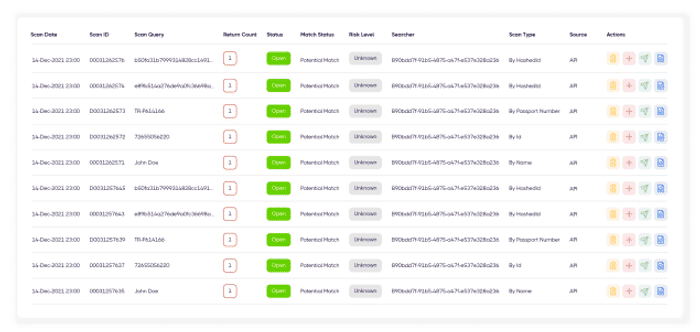
Sanction Scanner’s API connects risk scoring directly into your existing onboarding platform, CRM, or AML back office. Scores are calculated and returned in real time so compliance decisions happen within your workflow — not in a separate tool.
- No API integration fees
- No server costs
- 150ms average response time
- Works within your existing onboarding stack
Trusted by compliance teams making faster, better-evidenced risk decisions
"Since implementing Sanction Scanner, we have significantly reduced false positives. The time we previously spent on false positive alarms can now be directed towards other aspects of the business."

Guy Shaked
Legal Counsel at ironSource
"What I like best is the real-time screening capability and automated alerts. It helps us detect potential matches instantly and take immediate action, which is critical for our AML compliance."

Tolgahan Kapanci
Head of Compliance at PeP
"Sanction Scanner provided us the most comprehensive database to screen our clients. It includes lists from all over the world and is always up to date."

Gulnihal Akartepe
Global Vice President at TPAY
How BPN reduced false positives and made screening operationally sustainable
BPN, a payment and e-money services company, needed a screening setup that could handle high transaction volumes without overwhelming their compliance team. Here’s how they did it.
Read the case study →
Frequently asked questions
Customer risk assessment is the process of evaluating how likely a customer is to pose a money laundering or financial crime risk, based on factors such as their profile, geography, transaction behaviour, and any PEP or sanctions exposure. Regulators require a risk-based approach, which means the level of due diligence applied must reflect each customer’s individual risk level.
Yes. FATF recommendations and EU Anti-Money Laundering Directives require regulated institutions to apply a risk-based approach to customer due diligence. This means assessing each customer’s risk level and applying Simplified Due Diligence or Enhanced Due Diligence accordingly.
Common risk factors include customer type, country of residence or operation, source of funds, business sector, transaction volume and patterns, and any PEP or adverse media exposure. Sanction Scanner allows you to configure which factors to include and how to weight them based on your own risk appetite.
Dynamic risk scoring means customer risk scores update automatically when their profile changes — rather than being fixed at onboarding. If a customer’s transaction behaviour shifts, their country of residence changes, or they are newly designated as a PEP, their score recalculates and your team is alerted.
The rule engine lets compliance teams build and adjust risk scoring logic without developer involvement. You define the criteria, set the thresholds, and choose the risk tier outcomes using pre-built templates as a starting point or building rules from scratch.
Simplified Due Diligence applies to lower-risk customers and requires fewer verification steps. Enhanced Due Diligence applies to higher-risk customers — including PEPs and those from high-risk jurisdictions — and requires deeper verification, additional documentation, and more frequent review. Sanction Scanner routes customers to the appropriate tier automatically based on their risk score.
Yes. Risk scores update dynamically as customer profiles evolve. Ongoing monitoring feeds new information — changes in transaction behaviour, adverse media, PEP status, or geography — back into the scoring model, triggering alerts when a customer moves risk tier.
Yes. The API allows risk scoring to run within your existing onboarding platform, CRM, or case management system. Scores are returned in real time and can trigger downstream workflows automatically.
Every score calculation, rule application, and risk tier change is logged automatically with a full audit trail. If a regulator asks how a customer was classified and what due diligence was applied, the record is ready without additional preparation.