Transaction Monitoring Software for Regulated Businesses
Monitor every customer transaction in real time, detect suspicious activity as it happens, and give your compliance team the tools to act on what matters.

TRUSTED BY OVER 800+ CLIENTS


Real-time surveillance across every transaction your customers make
Every transaction is analysed the moment it occurs — amount, frequency, counterparty, geography, and behaviour pattern. Suspicious activity triggers an instant alert, not an end-of-day batch report.

100+
PRE-BUILT RULE SCENARIOS

<1s
REAL-TIME DETECTION

220+
JURISDICTIONS COVERED

800+
COMPLIANCE TEAMS
Real-Time Transaction Surveillance
Every transaction is analysed the moment it occurs — amount, frequency, counterparty, geography, and behaviour pattern. Suspicious activity triggers an instant alert, not an end-of-day batch report.
Rule-Based Detection
Define the scenarios your compliance program needs to catch. Set thresholds, build logic, combine variables without writing code. Start with ready-made rule sets calibrated for your industry or build your own from scratch.
Risk-Tiered Alerting
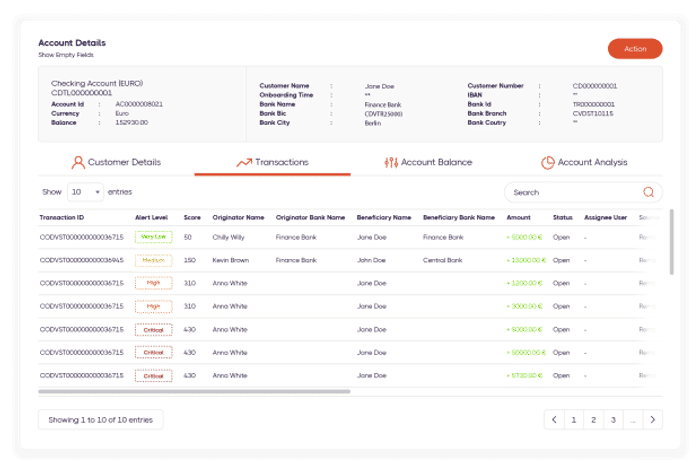
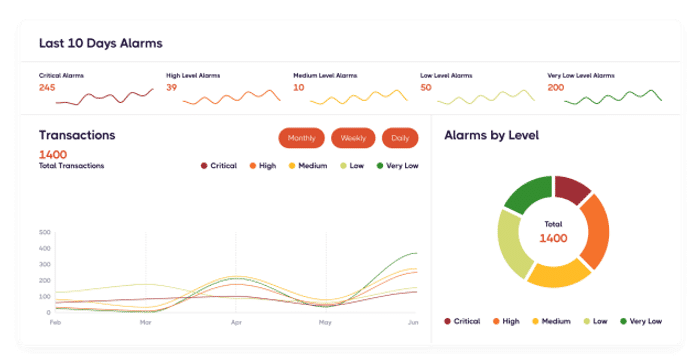
Alerts are generated and ranked by risk level from 1 to 5. Your team sees what requires urgent attention first, without having to sort through low-priority noise to find it.
Peer Group Analysis
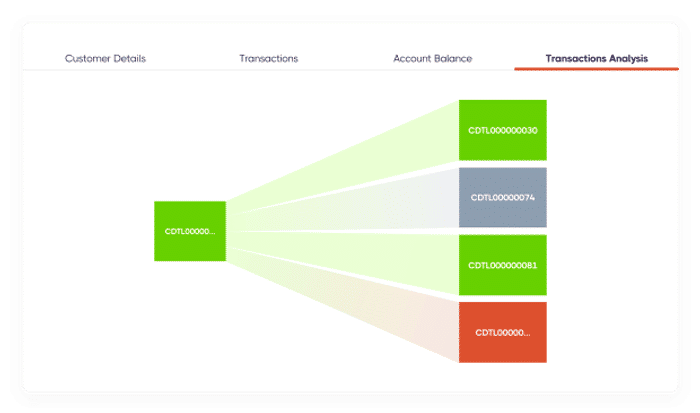
Compare individual account behaviour against similar accounts in your portfolio. Transactions that look normal in isolation often reveal patterns of concern when viewed against a peer group — this is where layering and structuring schemes surface.
The tools compliance teams need to detect, investigate, and report
Write detection rules in plain logic — no code required. Combine transaction variables, customer attributes, and risk scores into scenarios that reflect your actual compliance requirements.
Before any rule goes live, test it against historical or simulated data. Fine-tune thresholds, measure false positive rates, and validate detection logic before it touches real transactions.
Monitor international payment flows with support for SWIFT MT and ISO 20022 message formats. Key fields are extracted and screened automatically across cross-border transactions.
See transactions as they move through your system in real time. Filter by account, amount, geography, or risk level. Spot anomalies as they emerge rather than reviewing logs after the fact.
Every alert links directly to a case. Analysts can review transaction history, annotate findings, assign cases to team members, and escalate or dismiss — all within the platform.
When a suspicious activity report needs to be filed, the platform provides the audit trail and case documentation needed to complete it. Every decision made during the investigation is logged and retrievable.
Every rule trigger, alert, analyst action, and status change is recorded automatically. Regulatory review-ready at any point without additional preparation.

Live in hours, connected to the systems you already use
Sanction Scanner’s API integrates transaction monitoring directly into your core banking system, payment infrastructure, or compliance back office. Transactions feed into the monitoring engine automatically — no manual data exports, no batch delays.
- No API integration fees
- No server costs
- Sub-second average response time
- SWIFT MT and ISO 20022 compatible

Trusted by compliance teams managing transaction risk at scale
"Since implementing Sanction Scanner, we have significantly reduced false positives. The time we previously spent on false positive alarms can now be directed towards other aspects of the business."

Guy Shaked
Legal Counsel at ironSource
"What I like best is the real-time screening capability and automated alerts. It helps us detect potential matches instantly and take immediate action, which is critical for our AML compliance."

Tolgahan Kapanci
Head of Compliance at PeP
"Sanction Scanner provided us the most comprehensive database to screen our clients. It includes lists from all over the world and is always up to date."

Gulnihal Akartepe
Global Vice President at TPAY
How BPN reduced false positives and made screening operationally sustainable
BPN, a payment and e-money services company, needed a screening setup that could handle high transaction volumes without overwhelming their compliance team. Here’s how they did it.
Read the case study →
Frequently asked questions
Transaction monitoring is the continuous, real-time analysis of customer financial activity to detect patterns that may indicate money laundering, fraud, or other financial crime. It goes beyond point-in-time checks — it watches how customers behave over time and flags anomalies as they occur.
Yes. FATF recommendations, EU Anti-Money Laundering Directives, FinCEN rules, and most national AML frameworks require regulated institutions to monitor customer transactions on an ongoing basis and file Suspicious Activity Reports when unusual activity is identified.
You define the scenarios your compliance program needs to detect — large round-number transfers, rapid consecutive transactions, activity from high-risk jurisdictions, and so on. The system evaluates every transaction against those rules in real time and generates an alert when a rule is triggered.
The sandbox lets you test new or adjusted rules against historical or simulated transaction data before deploying them in your live environment. This allows you to validate detection logic, calibrate thresholds, and measure false positive rates without exposing your compliance program to untested rules.
Peer group analysis compares an individual account’s behaviour against a group of similar accounts — by industry, size, geography, or transaction type. Transactions that appear normal in isolation can reveal structuring or layering patterns when viewed against a peer group.
When an alert is escalated and a suspicious activity report needs to be filed, the platform provides the full case history, analyst annotations, and audit trail required to complete the report. Every step of the investigation is documented and retrievable.
Yes. The platform supports SWIFT MT and ISO 20022 message formats, enabling real-time monitoring of international payment flows. Key fields — sender, receiver, amount, BIC, and jurisdiction — are extracted and applied to your detection rules automatically.
Transaction monitoring analyses customer behaviour over time to detect suspicious patterns — it is about what your customers do. Transaction screening checks the parties on individual transactions against sanctions lists and watchlists before funds move — it is about who your customers are transacting with. Both are required for a complete compliance program.
Yes. You can apply different rule sets and alert thresholds to different customer segments — low, medium, high risk — so that monitoring intensity reflects each customer’s risk profile rather than applying a one-size-fits-all approach.
The transaction triggers an alert ranked by risk level. The alert feeds into the case management workflow where an analyst can review the transaction history, annotate findings, escalate the case, or dismiss it — with a full audit trail throughout.