Adverse Media Data for AML Compliance Screening
Negative news intelligence sourced from world-leading media outlets, categorised across 57 risk types, and available in 55+ languages — so your compliance team surfaces real risk, not noise.

TRUSTED BY OVER 800+ CLIENTS


Adverse media that goes as wide as the risk does
Source quality matters as much as coverage breadth. The credibility of what triggers a compliance alert is not an afterthought.
World-Leading News Sources
The dataset draws from high-reputation global media outlets including BBC, Al Jazeera, Reuters, and ABC News alongside thousands of regional and local sources. Source quality is not an afterthought — the credibility of what triggers a compliance alert matters as much as the coverage breadth.
57 Structured Risk Categories
Every adverse media hit is categorised across 57 risk types — from money laundering, bribery, and terror financing through to securities fraud, human trafficking, environmental crimes, and tax evasion. Compliance teams can filter by category and apply different workflows based on the nature of the exposure.
55+ Languages
Adverse media risk doesn't only appear in English. The dataset covers media in 55+ languages — ensuring that negative coverage from regional, local, and non-English sources is captured in the same screening call as global outlets.
Continuous Updates
The dataset is monitored and refreshed continuously. When new negative coverage emerges about an individual or entity, it is captured, categorised, and made available for screening — not batched into a weekly or monthly update cycle.
Scale and quality working together
Coverage includes world-leading outlets alongside regional and local sources — ensuring that risk emerging anywhere in the world, in any language, is captured before it reaches your compliance queue too late.

57
RISK CATEGORIES

55+
LANGUAGES COVERED

220+
COUNTRIES COVERED

15 min
MAX DATA REFRESH
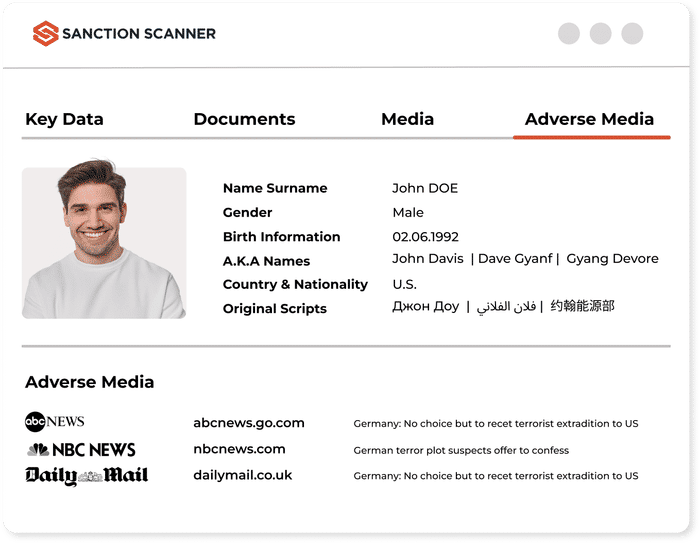
Not all negative news is equal — and neither is all adverse media data
Adverse media screening is only as good as the sources behind it. A system that generates alerts from low-quality blogs and unverified local publications creates noise. One built on credible, established media outlets creates signal.
Sanction Scanner's adverse media dataset is built on sourcing from world-leading outlets such as BBC, Al Jazeera, Reuters, and ABC News, alongside verified regional and specialist publications. Every source is assessed for reliability before being included.
Categorised, classified, and ready for compliance decisions
Hits are tagged against a structured taxonomy covering the full spectrum of financial crime and reputational risk — from core AML categories through to corporate governance risk, environmental crimes, and professional misconduct.
Run adverse media checks without the query subject being identifiable in the request — supporting privacy-sensitive due diligence workflows.
Results from non-English sources can be translated automatically, making adverse media coverage from 55+ language environments accessible to compliance teams in any language.

What compliance teams say about Sanction Scanner
"Sanction Scanner provided us the most comprehensive database to screen our clients. It includes lists from all over the world and is always up to date."

Gulnihal Akartepe
Global Vice President at TPAY
"Since implementing Sanction Scanner, we have significantly reduced false positives. The time we previously spent on false positive alarms can now be directed towards other aspects of the business."

Guy Shaked
Legal Counsel at ironSource
How BPN reduced false positives and made screening operationally sustainable
BPN, a payment and e-money services company, needed a screening setup that could handle high transaction volumes without overwhelming their compliance team. Here’s how they did it.
Read the case study →
Adverse media at the core of your risk picture
Frequently asked questions
Adverse media screening is the automated process of monitoring global news sources, publications, and media databases for negative coverage of individuals or entities — specifically coverage that may indicate financial crime risk, regulatory violations, or reputational exposure. It forms a core component of customer due diligence alongside sanctions and PEP screening.
FATF recommendations and EU Anti-Money Laundering Directives require regulated institutions to conduct negative news checks as part of their customer due diligence and enhanced due diligence processes. Adverse media coverage can indicate risk that has not yet appeared on any official sanctions or watchlist — making it an essential early-warning layer in any AML program.
Sanctions and PEP screening check customers against structured lists — they tell you who is officially designated or politically exposed. Adverse media screening reads actual news and media content — it can surface risk signals before they appear on any official list, including allegations, investigations, regulatory actions, and reputational incidents that may never result in a formal designation.
The dataset draws from world-leading global outlets — including BBC, Al Jazeera, Reuters, and ABC News — alongside thousands of verified regional, local, and specialist publications. Sources are assessed for reliability before inclusion. Coverage spans 220+ countries and 55+ languages.
Every adverse media hit is categorised against a structured taxonomy of 57 risk types covering the full spectrum of financial crime and reputational risk — including money laundering, terror financing, bribery and corruption, sanctions violations, securities fraud, human trafficking, drug trafficking, environmental crimes, tax evasion, and professional misconduct, among others. This categorisation enables compliance teams to filter results by risk type and apply differentiated workflows based on the nature of the exposure.
Yes. The dataset covers media in 55+ languages, and results from non-English sources can be translated automatically. This ensures that adverse media coverage from regional and local sources in any language is captured in the same screening process as global English-language outlets.
The dataset is monitored and refreshed continuously with a maximum interval of 15 minutes. New coverage is captured, categorised, and made available for screening as it emerges — not batched into periodic update cycles.
Yes. The API enables real-time adverse media checks within digital onboarding and KYC platforms. Results are returned as structured risk profiles — with category tags and severity indicators — so risk signals from media coverage are visible before account creation or client approval, without adding friction to the onboarding flow.
Yes. The 57 risk category taxonomy includes categories directly relevant to ESG risk — environmental crimes, labor exploitation, human rights violations, child labor issues, and wildlife trafficking. Compliance and risk teams can use adverse media screening to identify clients or partners with documented ESG-related exposure as part of broader risk management programs.
Yes. Masked query functionality allows adverse media checks to be run without the subject of the search being identifiable in the request — supporting privacy-sensitive due diligence processes.