Global Sanctions Data and Watchlists for AML Compliance
3,000+ sanctions lists and watchlists from 220+ countries, consolidated, structured, and refreshed every 15 minutes. The data behind every screening decision your compliance program makes.

TRUSTED BY OVER 800+ CLIENTS


Every major list. Every relevant jurisdiction. No gaps.
Consolidated, structured, and continuously updated sanctions data from all major international programs and 1,000+ additional sources.
Global Sanctions Lists
Every major international sanctions program is covered — OFAC SDN, UN Consolidated, EU Financial Sanctions, UK HMT, Australian Sanctions, Canadian OSFI, MAS, and 1,000+ additional government and regulatory lists. When a new designation is issued anywhere in the world, it is in the dataset within 15 minutes.
Watchlists and Enforcement Lists
Beyond formal sanctions, the dataset includes law enforcement watchlists, regulatory enforcement lists, Interpol notices, and other risk-relevant data sources that fall outside traditional sanctions programs but carry significant compliance weight.
Sanctioned Countries and Jurisdictions
Screen against country-level sanctions and restrictions. Identify which sanctions programs apply to a specific jurisdiction, what restrictions are in force, and how they affect your business — with nationality filtering for name-based searches.
57 Risk Categories
Every entity and individual in the dataset is classified across 57 structured risk categories — from money laundering and terror financing to bribery, securities fraud, and human trafficking. Compliance teams can filter, prioritise, and route alerts based on the specific risk type most relevant to their program.
The numbers behind the coverage
New lists are added continuously. Every existing list is monitored for updates and refreshed automatically — no manual intervention, no lag between a designation and its appearance in your screening results.

3,000+
SANCTIONS LISTS

220+
COUNTRIES COVERED

15 min
MAX DATA REFRESH

57
RISK CATEGORIES

The lists that matter, all in one place
Sanction Scanner consolidates data from the world's most authoritative sanctions and enforcement sources into a single, structured dataset.
Duplicate entries across multiple lists are identified and merged. A single sanctioned individual appearing on OFAC, UN, and EU lists is presented as one consolidated profile.
Every entity is indexed against known aliases and original-script variants. Searches in any alphabet return matches across all known name forms automatically.
Every record is tagged against 57 risk categories — from sanctions violation and terror financing through to corporate fraud, human trafficking, and environmental crimes.
Access the full dataset via API
The complete sanctions and watchlist dataset is accessible via Sanction Scanner's API. Integrate directly into your screening platform, onboarding system, or case management tool and query against the full dataset in real time.
Batch query support allows bulk lookups without multiple individual API calls.
Explore Developer Docs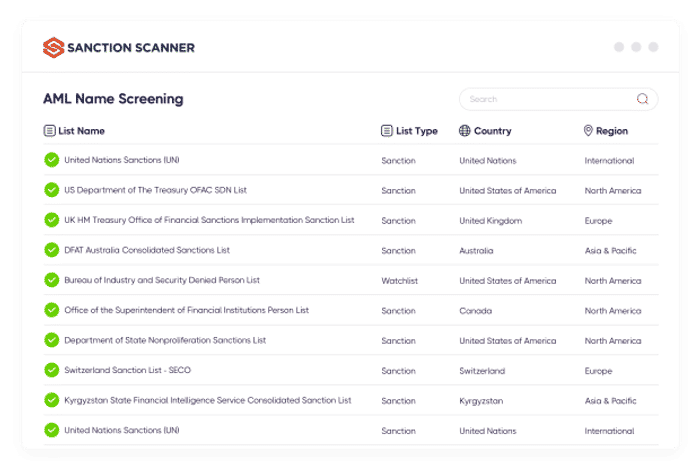
Trusted by compliance teams who can’t afford data gaps
"Sanction Scanner provided us the most comprehensive database to screen our clients. It includes lists from all over the world and is always up to date."

Gulnihal Akartepe
Global Vice President at TPAY
"With Sanction Scanner, we reduce the risks of money laundering and terrorist financing by controlling on local and international lists and avoiding risks during our onboarding process."

Oguzhan Akin
Banking and Expansion Manager (MEA) at Wise
How BPN reduced false positives and made screening operationally sustainable
BPN, a payment and e-money services company, needed a screening setup that could handle high transaction volumes without overwhelming their compliance team. Here’s how they did it.
Read the case study →
The data that powers your entire compliance program
Sanction Scanner's sanctions and watchlist data is the foundation of the screening and monitoring products in the platform. Every check at onboarding, during transactions, and through ongoing monitoring runs against the same consolidated, up-to-date dataset.
Frequently asked questions
The dataset includes 3,000+ global and local sanctions lists and watchlists across 220+ countries — covering OFAC SDN, UN Consolidated, EU Financial Sanctions, UK HMT, Australian Sanctions, Canadian OSFI, MAS, AUSTRAC, and 1,000+ additional government and regulatory lists. New lists are added continuously as regulatory programs expand.
All sanctions lists and watchlists are refreshed automatically with a maximum interval of 15 minutes. When a new designation is issued by any covered authority, it appears in the dataset within 15 minutes — no manual update cycle, no lag.
Every entity in the dataset is classified against a structured taxonomy of 57 risk categories covering the full spectrum of financial crime and regulatory risk — including money laundering, terror financing, bribery and corruption, sanctions violations, securities fraud, human trafficking, drug trafficking, environmental crimes, and more. This classification enables compliance teams to filter results by risk type and prioritise alerts based on the categories most relevant to their program.
A sanctions list is an official government or intergovernmental list of individuals, entities, or countries subject to specific legal restrictions. A watchlist is a broader category that includes law enforcement lists, regulatory enforcement actions, Interpol notices, and other risk-relevant sources that don't carry the same legal weight as formal sanctions but are important signals for compliance programs.
Yes. Country and jurisdiction-level sanctions are included — covering active sanctions programs, restricted jurisdictions, and embargoed countries. Nationality filtering allows name-based searches to be scoped to specific countries of interest.
AI-powered consolidation identifies and merges duplicate entries across lists. A single sanctioned individual appearing on multiple programs — OFAC, UN, and EU for example — is presented as one consolidated profile rather than three separate hits, reducing the manual reconciliation burden on your compliance team.
Yes. The API supports batch query mode for bulk lookups, returning structured results without requiring individual API calls per entity. This is particularly useful for portfolio re-screening and high-volume onboarding environments.
Yes. Every entity is indexed against known aliases and alternative name forms, including original-script variants in Arabic, Cyrillic, Chinese, and other alphabets. Searches in any supported script return matches across all known name forms automatically.