AML Transaction Screening Software for Payments and Remittances
Screen every sender and receiver against global sanctions lists and watchlists in real time before a single payment is processed.

TRUSTED BY OVER 800+ CLIENTS


Stop prohibited payments before they leave your system
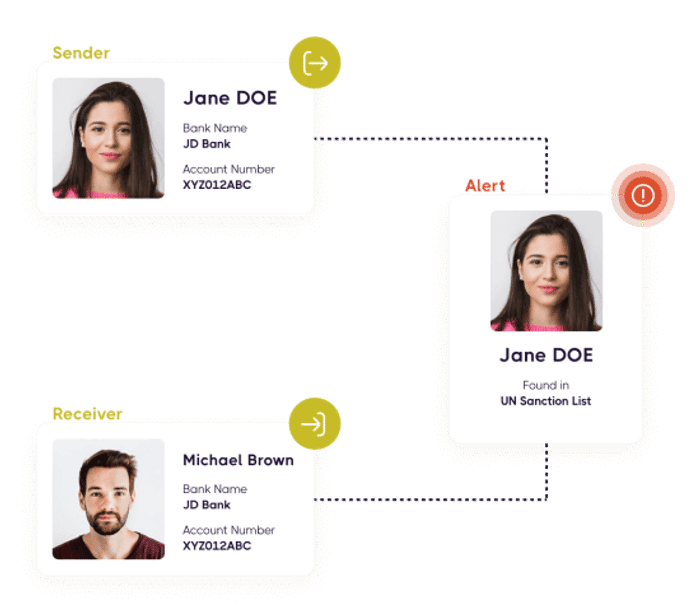
Every transaction party — sender, receiver, and any intermediary — is checked against global sanctions lists, PEP databases, and watchlists the moment a payment is initiated.

3,000+
GLOBAL SANCTIONS LISTS

220+
JURISDICTIONS COVERED

15 min
MAX LIST REFRESH

<1s
RESPONSE TIME
Real-Time Sender and Receiver Screening
Every transaction party is checked against global sanctions lists, PEP databases, and watchlists the moment a payment is initiated. If a match is found, the transaction is flagged or blocked before it is processed.
Sub-Second Response Times
High-volume payment environments cannot afford screening delays. Sanction Scanner returns results in milliseconds so that compliance checks happen within the transaction flow — not after it.
AI-Driven Fuzzy Matching
Sanctioned individuals don’t always appear under their exact registered name. Fuzzy matching logic identifies name variations, aliases, transliterations, and misspellings — catching matches that exact-name lookups would miss.
Configurable Screening Logic
Apply different screening rules by region, entity type, transaction amount, or business unit. Screen OFAC lists only for US-dollar flows, apply full global coverage for cross-border payments, or define any combination that fits your framework.
Built for compliance teams running high-volume payment operations
Screen sender name, receiver name, account number, country, currency, and transaction purpose in a single API call. More fields mean more accurate, defensible results.
When a match is confirmed, the transaction can be blocked automatically before processing. Your team is alerted with a full match profile for review and decision.
Screen SWIFT MT103, MT202, and ISO 20022 payment messages in real time. Key fields are extracted and screened automatically across correspondent banking and cross-border flows.
Define which lists apply to which payment types, geographies, or business units — with threshold and logic configuration that reflects your actual compliance policy.
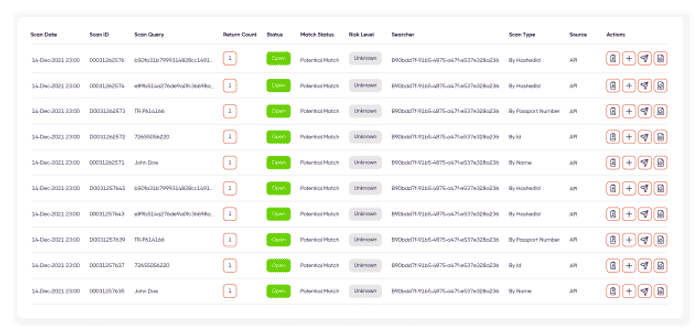
Every screening call, match result, and compliance decision is logged automatically. Audit-ready records are available at any point without additional preparation.
Integrate screening directly into your payment gateway, core banking system, or PSP platform. Screening runs within the transaction flow — not as a separate step that adds latency.


Embedded in your payment flow from day one
Sanction Scanner’s API is designed for high-throughput payment environments. Connect your transaction engine and have screening running in production within hours. Sub-second response times mean compliance checks happen inside the payment flow without adding perceptible delay for your customers.
- No API integration fees
- No server costs
- Sub-second average response time
- SWIFT MT and ISO 20022 compatible
Trusted by payment and compliance teams screening at scale
"Since implementing Sanction Scanner, we have significantly reduced false positives. The time we previously spent on false positive alarms can now be directed towards other aspects of the business."

Guy Shaked
Legal Counsel at ironSource
"What I like best is the real-time screening capability and automated alerts. It helps us detect potential matches instantly and take immediate action, which is critical for our AML compliance."

Tolgahan Kapanci
Head of Compliance at PeP
"Sanction Scanner provided us the most comprehensive database to screen our clients. It includes lists from all over the world and is always up to date."

Gulnihal Akartepe
Global Vice President at TPAY
How BPN reduced false positives and made screening operationally sustainable
BPN, a payment and e-money services company, needed a screening setup that could handle high transaction volumes without overwhelming their compliance team. Here’s how they did it.
Read the case study →
Complete your continuous compliance program

Screen customers against sanctions lists, PEP databases, and adverse media at onboarding before they ever initiate a transaction.
Explore AML Screening →Frequently asked questions
Transaction screening is the process of checking the parties involved in a financial transaction — sender, receiver, and intermediaries — against sanctions lists, PEP databases, and watchlists before the payment is processed. If a match is found, the transaction is flagged or blocked.
Transaction screening checks who is involved in each individual payment — it is a pre-transaction control. Transaction monitoring analyses patterns of customer behaviour over time to detect suspicious activity — it is an ongoing surveillance control. Both are required for a complete AML program.
Sanction Scanner screens against 3,000+ global and local lists including OFAC, UN, EU, UK HMT, MAS, and AUSTRAC, covering 220+ jurisdictions. All lists are updated automatically with a maximum refresh interval of 15 minutes.
Sanction Scanner returns screening results in sub-second response times, enabling compliance checks to run inside the payment flow without adding perceptible delay to the transaction.
Fuzzy matching identifies name variations, aliases, transliterations, and misspellings — catching sanctioned parties who appear under a slightly different name format than their official listing. Without it, exact-name lookups will miss matches that any experienced compliance officer would recognise.
Yes. When a confirmed match is found, the platform can block the transaction automatically before it is processed. Your compliance team receives an alert with the full match profile for review and final decision.
Yes. The platform screens SWIFT MT103, MT202, and ISO 20022 message formats in real time. Key fields — sender, receiver, amount, BIC, and jurisdiction — are extracted and screened automatically, enabling compliance across correspondent banking and cross-border payment flows.
Yes. You can apply different screening logic by region, entity type, transaction amount, or business unit — for example, applying OFAC-only rules to US-dollar flows while applying full global coverage to cross-border payments.
Yes. Global AML standards require regulated institutions to screen transactions for links to sanctioned entities and prohibited parties as a core component of their AML framework.
Via API. Sanction Scanner’s API embeds screening directly into payment gateways, core banking systems, and PSP platforms. Screening runs within the transaction flow and returns results in milliseconds — no manual handoff, no batch delays.