AML Ongoing Monitoring Software for Continuous Compliance
Automatically re-screen your entire customer portfolio every day against updated sanctions lists, PEP databases, and adverse media — and receive instant alerts when a customer’s risk profile changes.

TRUSTED BY OVER 800+ CLIENTS


Know the moment a customer’s risk profile changes
Sanctions lists, PEP databases, and adverse media sources update constantly. Ongoing monitoring ensures your entire customer base is re-evaluated against those changes automatically — without your team doing it manually.

3,000+
GLOBAL SANCTIONS LISTS

220+
JURISDICTIONS COVERED

15 min
MAX LIST REFRESH

800+
COMPLIANCE TEAMS
Automated Daily Re-Screening
Your full customer portfolio is re-screened against updated lists automatically every day. You do not need to trigger it manually — every customer is evaluated on a schedule you define, without any ongoing effort from your team.
Real-Time Risk Profile Alerts
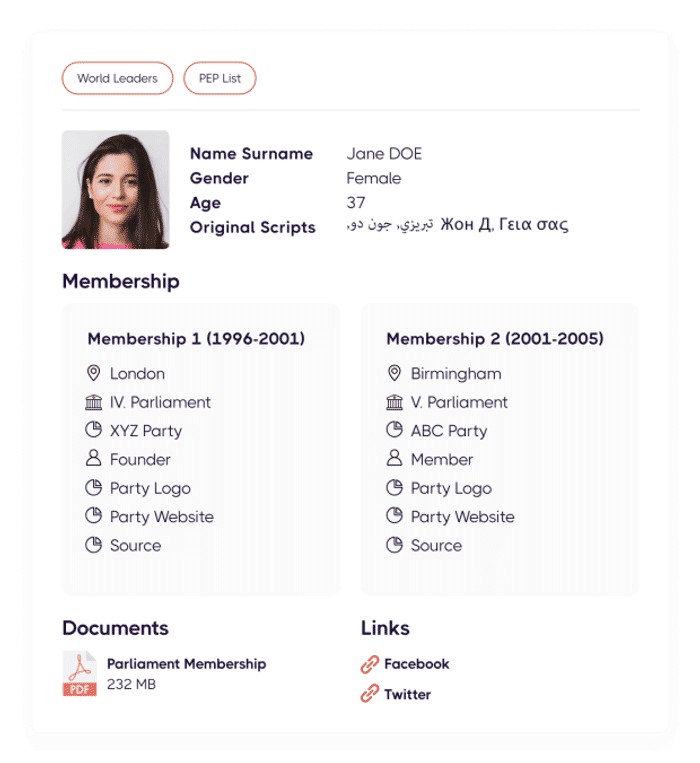
When a customer is newly added to a sanctions list, gains PEP status, or appears in adverse media, your compliance team is alerted immediately. No periodic batch review — you know the moment something changes.
Risk-Based Monitoring Frequency
Higher-risk customers can be re-screened more frequently than low-risk ones. Configure monitoring frequency by customer risk score, product type, or geography to focus resource on the customers that need it most.
Coverage Across Sanctions, PEP & Adverse Media
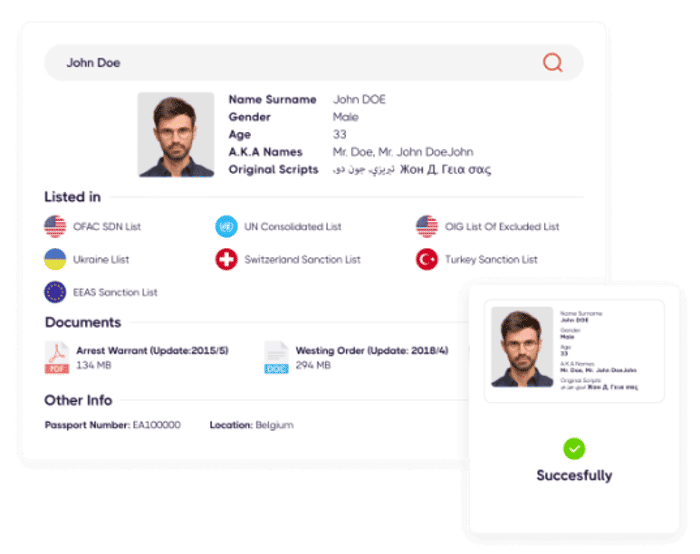
Re-screening covers the full risk picture: global sanctions lists, PEP databases, adverse media sources in 55+ languages, and relevant watchlists — all from a single platform with a single integration.
Built to keep your customer base clean between onboarding events
Set daily, weekly, or custom-frequency re-screening per customer segment or risk tier. High-risk customers can be re-screened multiple times per day; standard customers run on a daily or weekly cycle.
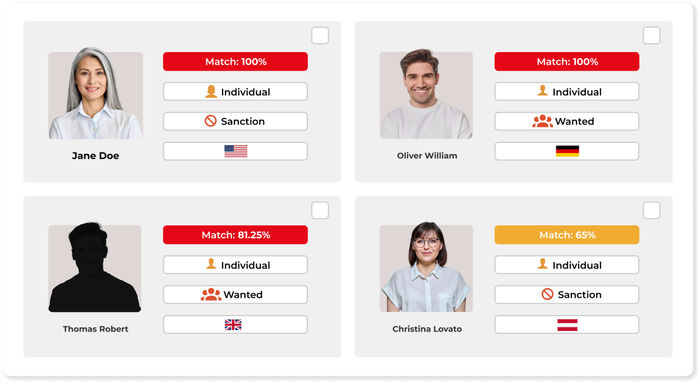
When any customer triggers a new match — whether a new sanctions designation, PEP status change, or adverse media hit — an alert is created and routed to the appropriate team member for review.
Every re-screening event, match result, alert, and compliance decision is logged automatically with timestamp and user attribution. Your audit trail is always complete without any additional preparation steps.
Re-screen your entire customer base on demand following a major list update or regulatory change. Upload a customer list and run a bulk re-screen in minutes, with results available immediately for review.
Alerts from ongoing monitoring flow directly into case management. Analysts review the match, add investigation notes, record decisions, and close cases — all within the same platform, with every action logged.
Trigger re-screening programmatically via API whenever a customer record is updated. Integrate with your CRM, KYC platform, or core banking system to keep ongoing monitoring in sync with your customer data.


Plug into your existing compliance workflow in hours
Sanction Scanner’s ongoing monitoring API connects to your customer database, CRM, or KYC platform so that re-screening runs automatically without manual exports or batch jobs. List updates are reflected in real time — customers are always screened against the most current data.
- No API integration fees
- No server costs
- Lists refresh every 15 minutes
- Covers sanctions, PEP, and adverse media
Trusted by compliance teams monitoring thousands of customers daily
"Since implementing Sanction Scanner, we have significantly reduced false positives. The time we previously spent on false positive alarms can now be directed towards other aspects of the business."

Guy Shaked
Legal Counsel at ironSource
"What I like best is the real-time screening capability and automated alerts. It helps us detect potential matches instantly and take immediate action, which is critical for our AML compliance."

Tolgahan Kapanci
Head of Compliance at PeP
"Sanction Scanner provided us the most comprehensive database to screen our clients. It includes lists from all over the world and is always up to date."

Gulnihal Akartepe
Global Vice President at TPAY
How BPN reduced false positives and made screening operationally sustainable
BPN, a payment and e-money services company, needed a screening setup that could handle high transaction volumes without overwhelming their compliance team. Here’s how they did it.
Read the case study →
Ongoing monitoring is strongest when connected to your full compliance stack
Ongoing monitoring re-screens your existing customers, but it works best when paired with AML screening at onboarding and a customer risk assessment layer that determines how frequently each customer needs re-screening.
Frequently asked questions
AML ongoing monitoring is the continuous or periodic re-screening of an existing customer base against current sanctions lists, PEP databases, and adverse media sources. Rather than only checking customers at onboarding, ongoing monitoring ensures that changes in a customer’s risk status — such as a new sanctions designation or a PEP appointment — are detected quickly and acted on before exposure becomes a regulatory problem.
AML regulations in most jurisdictions — including the FATF recommendations, EU AML directives, FinCEN rules, and UK Money Laundering Regulations — require regulated firms to apply ongoing due diligence to their existing customers, not just at onboarding. This means monitoring customer activity and risk profiles over time. Failure to detect a sanctioned customer or a newly designated PEP can result in regulatory penalties, even if the customer was screened correctly at onboarding.
The required frequency depends on the customer’s risk rating and your regulatory framework. High-risk customers should be re-screened at least daily, and some regulators expect near-real-time monitoring for PEP-exposed or high-value relationships. Low-risk customers may be re-screened weekly or monthly. A risk-based approach — where re-screening frequency matches the risk tier of each customer — is both the regulatory standard and the most operationally efficient approach.
Ongoing monitoring focuses on changes to a customer’s identity and risk profile — such as being added to a sanctions list, gaining PEP status, or appearing in adverse media. Transaction monitoring focuses on the financial behaviour of existing customers — looking for suspicious patterns like structuring, layering, or unusual cash flows. Both are required components of a robust AML programme and work best when integrated together.
Yes. Sanction Scanner’s ongoing monitoring covers sanctions lists, PEP databases, and adverse media sources simultaneously. Adverse media monitoring scans news sources across 55+ languages to detect negative coverage linked to financial crime, corruption, fraud, or regulatory action. Because these sources update continuously, re-screening against adverse media is just as important as re-screening against formal sanctions lists.
Sanction Scanner refreshes its sanctions data within 15 minutes of any list update. This means that when a regulator adds a new name to a sanctions list — such as OFAC, UN, or EU — your ongoing monitoring system will be working against the updated list within 15 minutes. Customers who match the new designation will trigger alerts at their next scheduled re-screening, or immediately if your configuration calls for event-driven re-screening.
When a re-screening event produces a match, the system creates an alert and routes it to the appropriate compliance analyst. The alert includes the customer record, the matched list entry, and all relevant context. The analyst reviews the match, determines whether it is a true positive or a false positive, records their decision, and takes any required action — all within the case management workflow, with a complete audit trail preserved automatically.
Yes. In addition to scheduled re-screening, you can trigger a bulk portfolio re-screen at any time — for example, following a major sanctions update or a change in your regulatory obligations. You upload a customer list or use the API to submit a batch, and results are returned with all matches identified for review. Bulk re-screening is useful for periodic compliance certifications or when responding to a specific regulatory request.
Yes. Every re-screening event is logged automatically, including the date and time of screening, the lists screened against, the match results returned, any alerts created, and the decisions made by analysts. This full audit trail is available for regulatory review at any point without additional preparation. It documents both that re-screening occurred and how any resulting alerts were handled.
Integration is via REST API. You connect Sanction Scanner to your customer database, CRM, or KYC platform so that customer records are passed to the ongoing monitoring system automatically. Re-screening can be triggered on a schedule, on demand, or in response to customer record updates. Sanction Scanner provides developer documentation, sandbox environments, and onboarding support to get the integration live without delay.