

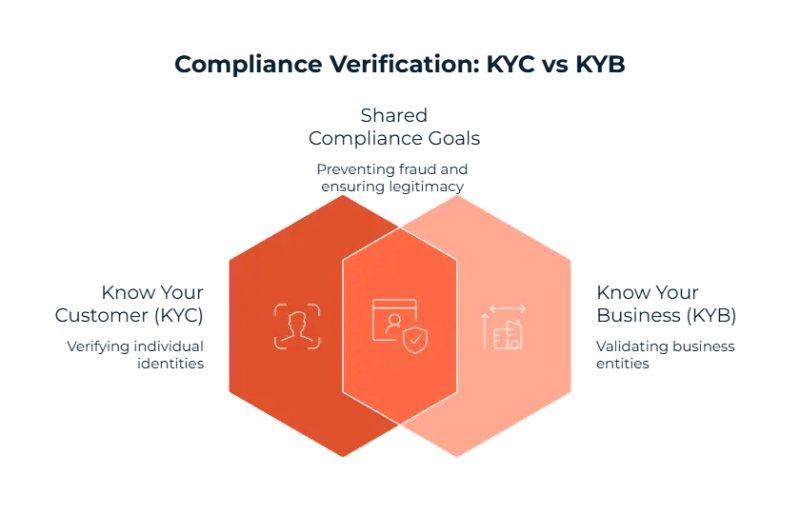
KYC and KYB are often confused, but they serve different purposes. KYC – Know Your Customer – is about people. It verifies a person's ID, date of birth, address and all the other information that verifies a person is who they claim to be. Know Your Business (KYB) applies the same idea to companies, looking at business registration, ownership structure, and the ultimate beneficial owners (UBOs) behind the entity.
What they share is the goal. Both exist to stop money laundering, and both are steps a firm has to clear for anti-money laundering (AML) compliance. Regulators are not treating either one lightly. In 2025 the UK's Financial Conduct Authority fined two banks for failings in exactly these areas.
Definition of KYC (Know Your Customer)
KYC works at the individual level, usually at onboarding. It also sets the customer's risk level, so the people who need a closer look get one. For most firms it is the first thing standing between them and money laundering or other financial crime.
Documents still matter, a passport or licence and proof of address. But in 2025 KYC leans on biometrics too: facial recognition, fingerprints, liveness checks. Once identity is confirmed, the customer is screened against sanctions and PEP lists, which lowers the odds of onboarding a sanctioned party or waving through a high-risk individual.
Monzo shows what happens when this slips. The FCA fined the bank £21 million after it kept opening accounts for high-risk customers, some of whom gave plainly fake addresses. One used Buckingham Palace. Another used Monzo's own head office. No red flags went up.

Key KYC Regulations to Know
A few rules sit behind KYC. The EU's Sixth Anti-Money Laundering Directive (AMLD6) imposes penalties for money laundering and mandates identity verification in member states. Globally, FATF Recommendation 10 sets the standard for Customer Due Diligence (CDD) in the verification of customers and companies. In the U.S., the FinCEN CDD Rule requires banks and other financial firms to verify customer identities and ensure that information is accurate.
What Is KYB (Know Your Business) and What Does It Involve?
KYB is KYC at the company level. It does the identity work above, then goes further: validating licences, reviewing financial records, and running adverse media screening on the business. Tax ID validation is part of it too, so a company is not quietly tied to tax fraud.
Barclays is the cautionary tale here. The FCA fined it £42 million in 2025 for weak KYB oversight. In one case the bank opened a client account for WealthTek without checking the Financial Services Register, which would have shown the firm was not allowed to hold client money. In another, it failed to look hard enough at Stunt & Co, whose account took in £46.8 million tied to a money-laundering operation. Gaps like these run into tens of millions in fines.
Key KYB Regulations to Know
The main standard behind KYB is FATF Recommendation 24, which pushes firms to identify and verify UBOs so ownership is transparent. In the US, the Corporate Transparency Act (CTA) makes companies disclose ownership, which leaves fewer places to hide illicit money behind a corporate shell. AMLD6 does the same job in Europe. Follow these rules and you keep shell companies at arm's length and stay clear of penalties.
KYB vs KYC: Key Differences
The split is simple at the top: KYC is for individuals, KYB is for legal entities. KYC proves a person is genuine; KYB proves a company is. The rulebooks differ too. KYC answers to FATF Recommendation 10, AMLD6, and the FinCEN CDD Rule, while KYB answers to FATF Recommendation 24, the CTA, and AMLD6.
In practice the checks diverge. KYC compares a customer's ID, address, and biometrics against official records. KYB is about finding the UBOs and validating licences and tax IDs. Sanctions, PEP, and adverse media screening belong in both. KYC tends to speed up with electronic KYC (eKYC) tools; KYB speeds up with dedicated UBO tools.
Why Is KYB a Priority in 2026?
Ownership transparency is still what regulators want most, and that keeps KYB near the top of the compliance list. Shell companies have not gone away, and firms would rather not be the one left holding a risky relationship. The regulatory picture has split by region, though. In the EU, the new AML Authority (AMLA) has been operational since mid-2025, and the single rulebook (AMLR) tightens beneficial-ownership rules from 2027. In the US, the Corporate Transparency Act moved the other way: since March 2025 domestic companies are exempt from beneficial-ownership reporting, and the duty now falls mainly on foreign companies registered to do business there. Add fast-growing crypto and fintech firms, which regulators have met with stricter audits, and KYB stays a live requirement heading into 2026.
Why is KYB More Challenging Than KYC?
| Challenge | Why It Matters |
| Incomplete data | Slows verification |
| Complex UBOs | Obscures ownership |
| Cross-border rules | Multiple standards |
| No global KYB framework | Manual work, legal risk |
KYB and KYC in Practice
| Industry | KYC Use Case | KYB Use Case |
| Fintechs | E-wallet ID checks | SME onboarding |
| Crypto | Retail AML compliance | Institutional KYB |
| Marketplaces | Buyer verification | Seller legitimacy |
KYC vs KYB on Different Industries:
Fintechs and Neobanks
Both are correct. KYC includes personal account onboarding, checking customer identity with documents, screening and biometrics. KYB comes in when a vendor or business account opens, confirming the company is real and its ownership is clear. It is also where fintechs tend to get caught out, when controls fall behind fast growth.

Crypto Exchanges
On a crypto exchange, KYC covers retail traders, who must be identified before they can move funds. KYB covers over-the-counter desks, custodians, and corporate clients. Because these businesses handle large volumes, confirming they are safe and transparent protects both sides.
Marketplaces and Payment Service Providers (PSPs)
Marketplaces and payment service providers rely on KYC to protect consumers, verifying the customer before any transaction. KYB confirms the legitimacy of vendors, partners, and business accounts, checking registration and status to guard against money laundering.
Simplify KYC & KYB with Sanction Scanner
Sanction Scanner screens individuals and companies at onboarding and on an ongoing basis thereafter. UBO and registry data in real time keeps out illegitimate companies and compliance reports are audit-ready and filed. It's a one platform that combines KYC and KYB and you can request a demo to see how it can fit your compliance needs.
Sources
- FCA, FCA fines Monzo £21m for failings in financial crime controls
- FCA, FCA fines Barclays £42 million for poor handling of financial crime risks
- FATF, International Standards on Combating Money Laundering (Recommendations 10 and 24)
- FinCEN, Customer Due Diligence (CDD) Final Rule
- EUR-Lex, Directive (EU) 2024/1640 (AMLD6)
FAQ's Blog Post
KYB verifies the legitimacy and ownership of businesses, while KYC focuses on verifying individual customers. Both are essential for AML compliance.
It helps institutions detect shell companies, hidden ownership, and high-risk business relationships. This prevents money laundering and fraud.
It ensures customers are who they claim to be and assesses their risk profile. This protects businesses from identity fraud and financial crime.
Banks, payment providers, fintechs, and other regulated entities dealing with corporate clients. It is mandatory in many jurisdictions under AML laws.
Any business providing financial services or regulated activities to individuals. This includes banks, brokers, crypto exchanges, and insurers.
Company registration documents, shareholder details, Ultimate Beneficial Owner (UBO) identification, and business licenses.
Government-issued ID, proof of address, and sometimes proof of income or source of funds.
Yes, many compliance systems integrate both processes. This ensures full verification of both the business entity and its owners.


